Picture this: a major expressway that usually hums with weekend traffic suddenly becomes a parking lot stretching for kilometers. Vehicles sit motionless for over thirty hours. People run out of water, food, and patience.
No accident involving a regular car caused it. It was a tanker carrying highly flammable propylene gas that overturned, leaked, and turned the entire stretch into a no-go zone until experts could safely upright the vehicle and neutralize the hazard.
This happened on the Mumbai-Pune Expressway, and it became one of the clearest reminders of how quickly things can go wrong when dangerous goods are on the move.
That one event didn't just cause problems for thousands of people. It showed how close to disaster routine logistics can be. We at Velocity Courier take every shipment of dangerous goods very seriously because we know that the difference between a smooth delivery and a newsworthy disruption is often just being prepared and following the rules.
Let's go over everything you need to know about moving dangerous goods in India, including the rules, the risks, the safety measures, and the steps you can take to keep everyone safe.
What Are Dangerous Goods
Dangerous goods are things that can hurt people, property, or the environment while they are being moved. There are a lot of things on the list, like flammable liquids, compressed gases, corrosive acids, toxic substances, explosives, radioactive materials, oxidizing agents, and more.
In everyday terms, these are the materials that make headlines when something goes wrong. A leaking gas cylinder, a spilled chemical drum, and a battery pack that overheats each carry a specific hazard that must be understood and controlled from the moment they leave the warehouse until they reach their destination.
Velocity offers you a guidebook detailing hazardous goods.
The Nine-Class System That Rules the Road
India follows the United Nations classification system for dangerous goods, which neatly divides hazards into nine classes. Every professional in the supply chain speaks this language.
- Class 1: Explosives
- Class 2: Gases (compressed, flammable, toxic, or non-flammable)
- Class 3: Flammable liquids
- Class 4: Flammable solids, substances liable to spontaneous combustion, substances that emit flammable gases on contact with water
- Class 5: Oxidizing substances and organic peroxides
- Class 6: Toxic and infectious substances
- Class 7: Radioactive material
- Class 8: Corrosive substances
- Class 9: Miscellaneous dangerous substances (lithium batteries, dry ice, environmentally hazardous substances, etc.)
Each class has detailed subdivisions, and every substance is assigned a four-digit UN number. That number is the passport of the cargo. It tells everyone exactly what they are dealing with and how seriously to treat it.
The Legal Backbone in India
The Central Motor Vehicles Rules are the main rules for transporting dangerous goods by road. Indian standards that are very similar to international standards give more detailed technical advice.
Some of the most important requirements are proper classification and identification, packaging that has been tested for performance, correct hazard warning labels and placards, vehicles that are safe to drive and have the right equipment (spark arrestors, fire extinguishers, emergency information panels), trained and certified drivers, and emergency response information that is written down and kept on the vehicle.
Non-compliance is not just paperwork trouble. It can lead to detention of the vehicle, heavy fines, license suspension, and, in serious cases, criminal liability.
Packaging: Where Safety Begins
Packaging is not decoration. It is the first and most critical barrier between the hazard and the outside world. Dangerous goods must be packed in UN-certified packaging that has been drop-tested, stack-tested, pressure-tested, and vibration-tested. Packaging is assigned to one of three packing groups depending on the degree of danger:
- Packing Group I: great danger
- Packing Group II: medium danger
- Packing Group III: low danger
The consignor is legally responsible for selecting the right packaging, marking it correctly, and ensuring it is closed and sealed properly. A poorly chosen or damaged package can turn a minor incident into a major emergency.
Labels, Placards, and Vehicle Marking
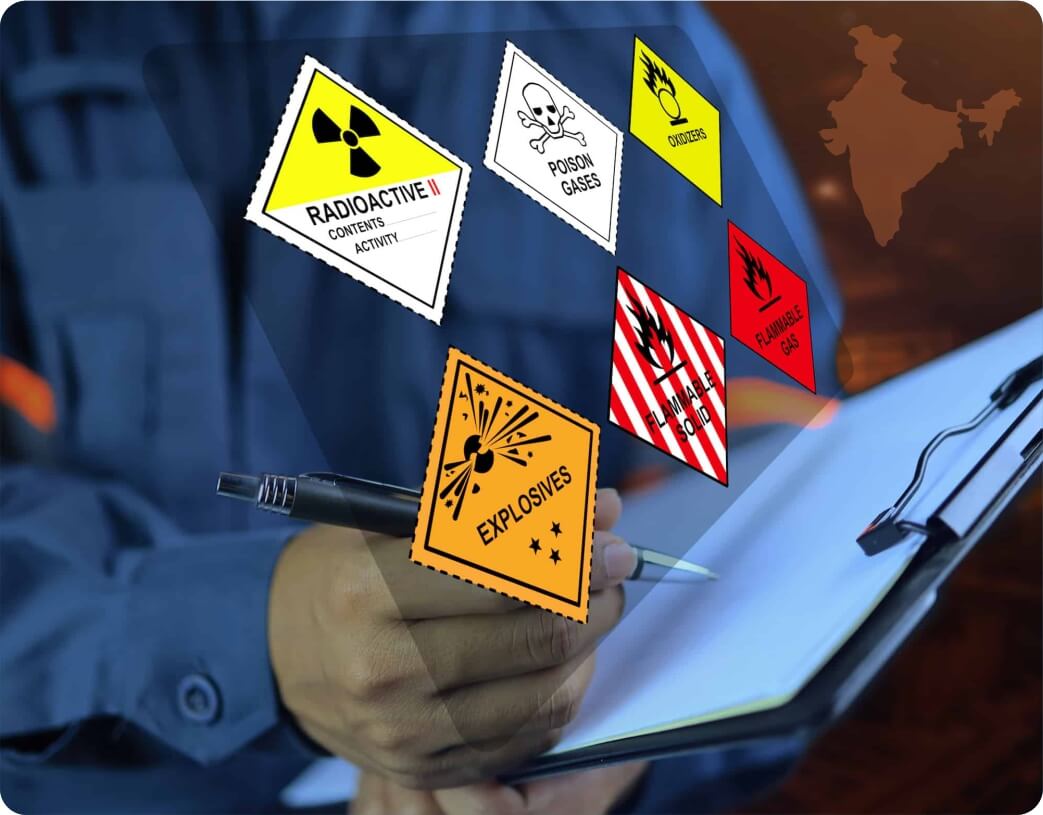
You cannot miss a vehicle carrying dangerous goods, and that is intentional. Every package must carry diamond-shaped hazard labels showing the class number and the hazard symbol. Vehicles must display larger placards on all four sides, along with an emergency information panel that includes the UN number, the proper shipping name, contact telephone numbers for emergencies, and the hazard class identifier.
These markings are not optional decoration. They allow firefighters, police, and medical teams to make life-saving decisions within seconds of arriving at an incident.
Drivers: The Most Important Link
A driver who is transporting dangerous goods is doing more than just driving. They are in charge of a moving danger. Drivers in India have to take certain training and refresher courses every three years.
The curriculum includes how to recognize hazards, how to load and unload safely, how to use personal protective equipment, how to put out fires and clean up spills, how to drive defensively, and how to communicate in an emergency.
A lot of companies go above and beyond the bare minimum by offering simulator-based training, route-specific briefings, and regular medical check-ups. There can be hours of traffic chaos or worse between a well-prepared driver and one who cuts corners.
Velocity ensures the safety of your courier through rigorous inspections and trusted drivers.
Emergency Response: Plan Before You Panic
Every consignment of dangerous goods must be accompanied by a Transport Emergency Card (TREM card) that lists the nature of the hazard, immediate actions to be taken, protective equipment required, neutralizing agents (if applicable), and contact details of the consignor, carrier, and emergency services.
When an incident occurs, the driver's first responsibility is to secure the area, prevent ignition sources, and notify authorities. A well-executed plan can limit damage to the vehicle and cargo. A poorly executed one can turn a manageable spill into a multi-hour highway closure.
Segregation: Keeping Enemies Apart
Some hazards do not play well together. Flammable liquids must be kept away from oxidizing substances. Acids must be segregated from bases. Toxic materials must not travel next to foodstuffs. The segregation rules are detailed and mandatory. Ignoring them is like storing fireworks next to an open flame.
Incident Reporting: Learning from Every Close Call
The rules are clear when things go wrong. The driver must immediately call the nearest police station and the appropriate authorities, give them all the information about the shipment and the incident, and follow any instructions given by emergency responders. The transporter and consignor must also file official reports so that lessons can be learned and the risks in the future can be lowered.
Best Practices That Actually Work
Pick carriers that keep their vehicles in good shape and can track them in real time. Make sure the drivers are trained, well-rested, and have the right tools. Check that all the papers, labels, and signs are in the right place before the car leaves the gate. Do practice drills so that everyone knows what to do if the worst happens.
These are the things we do every day at Velocity Courier . We use smart technology and experienced teams to make sure that dangerous cargo moves safely and on time, so it doesn't become a traffic nightmare tomorrow.
Transporting dangerous goods is not about taking chances. It is about eliminating them. When you get the classification, packaging, labeling, training, and emergency planning right, the road stays open, and the headlines stay quiet.
Need a reliable partner for your next hazardous shipment? Visit Velocity and let us show you how smoothly dangerous goods can move when everything is done by the book.
 LOGIN
LOGIN